SF51 - Boston Science Fiction Film Festival
February 11th-February 16th, 2026
Reviews are posted alphabetically by film.
Click on the poster for the review!!! More coming as we near the festival!!!

Feature Film Reviews



Short Film Reviews
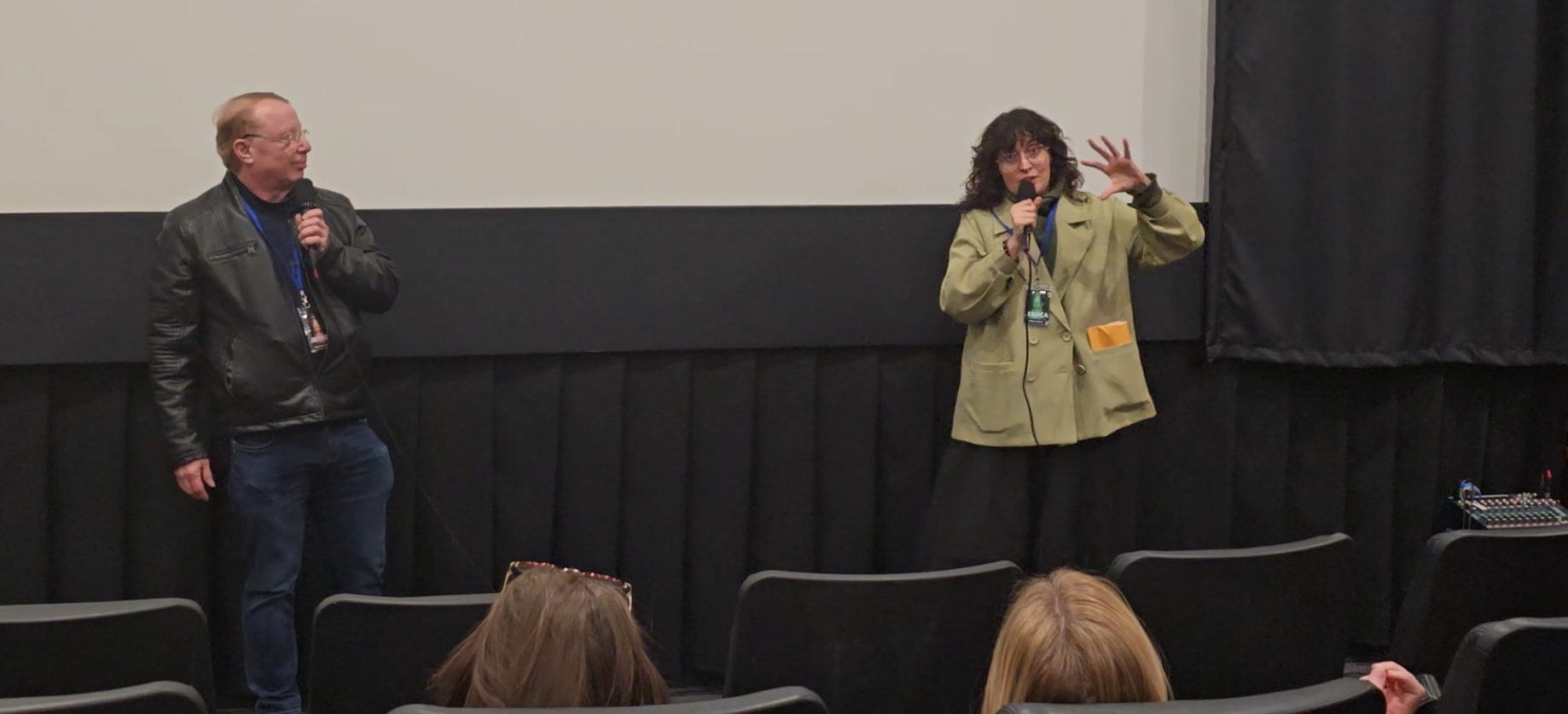
Q & A Sessions with Filmmakers and Other Guests in Attendance of Feature Films
After Us, The Flood
⭐️⭐️⭐️⭐️
Feature Film (Narrative)
Film Production Companies: Art Films Production and Tasse Film
Rating: NR
Language: Finnish
Director: Arto Halnen
Writer: Ossi Hakala
Starring: Elias Westerberg, Linnea Leino, Tuomas Nilsson, Kasperi Kola,
Petteri Summanen, Antti Reini, Robert Enckell, Pihla Penttinen,
Hannu-Pekka Björkman and Jari Salmi
“None of us is a saviour. The most we can do is help others save themselves. Otherwise we’re just trying to own them. And you can’t own anyone.”
In the year 2064, global warming has completely obliterated the planet, transforming it into a dystopian wasteland for most—unless you are among the few fortunate enough to have the wealth to live as if nothing ever happened. Such is the case for Henrik (played by Enckell in these later years). There is, however, a controlling authority that believes the damage can still be reversed. With the aid of experimental time-travel technology, Henrik and his former friend Sakari (played by Björkman in these later years) are tasked with traveling back to 2024 to publish the blueprint plans for a fusion reactor—the very invention that ultimately helped trigger the global climate crisis. The hope is that by releasing the plans freely to the public, rather than selling them to a powerful conglomerate, history can be redirected.
The two men, long estranged after a falling out over the years, (that will be explained) agree to the mission under strict conditions: they are to complete this single act and interfere with nothing else, lest they cause irreparable damage to the timeline. They are told that upon traveling back, they will be reborn, retain their memories, and simply relive their lives.
When the clocks turn back, things do not go as planned. Henrik and Sakari do not return to their original bodies. Instead, Henrik is reborn as Markku, a boy he once bullied during his formative years. Markku, unlike the academically gifted Henrik, is the son of an auto mechanic and an easy target for more popular classmates. Sakari fares even worse, returning not as himself, but as a dog. Through a brief montage, we watch their lives unfold again until the story reaches its pivotal moment: Henrik, now living as Markku (played by Westerberg), reconnects with Sakari (Kola) and the third essential member of their future team, Julia (Leino). As Henrik struggles to reconcile his past identity with his present existence, he is forced to manipulate events in order to complete the mission—while simultaneously watching his former self (Nilsson) move through life unchanged. The process becomes as much about self-reflection and accountability as it is about saving the future.
While this may sound like a complicated narrative, After Us, the Flood is surprisingly easy to follow. Hakala’s script provides just enough exposition to keep the audience oriented without becoming bogged down in dense sci-fi mechanics. As the story unfolds, initial impressions of the characters begin to shift, revealing how cycles of verbal and physical abuse have shaped their behavior and relationships. What begins as a mission to correct the future gradually transforms into a thoughtful character study, examining how small choices compound over time. Halonen works confidently with his cast, guiding them through multiple versions of the same characters across diverging timelines. The result is an intriguing intersection of intimate human drama and speculative science fiction—one that feels emotionally grounded even when the concepts themselves verge on the far-fetched.
Visually, the film grounds itself in a strong sense of naturalism, particularly in its depiction of the present day. Rather than leaning into sleek, high-tech environments typical of the genre, After Us, the Flood unfolds in familiar, everyday spaces—schools, garages, kitchens, and modest homes—where conversations about time travel and climate collapse occur with an almost unsettling casualness. This approach, supported by Teppo Järvinen’s grounded production design and Pini Hellstedt’s restrained, slick cinematography, reinforces the film’s central idea: that world-altering decisions are often made in ordinary places by ordinary people. The lack of visual spectacle becomes a strength, keeping the focus on character and consequence rather than futuristic excess.
All in all, the film is a unique look at second chances and a reminder that our time is limited—and that the consequences of our actions have a way of rippling far beyond what we initially imagine.
Review by Cinephile Mike
Dream Theatre
⭐️⭐️⭐️
Feature Film (Narrative)
Film Production Companies: Dirty Toe Productions
Rating: NR
Language: Finnish
Director: Daniel Limmer
Writer: Daniel Limmer
Starring: Isabella Händler, Violetta Zupancic and Christian Schönleitner
“Time waits for no one.”
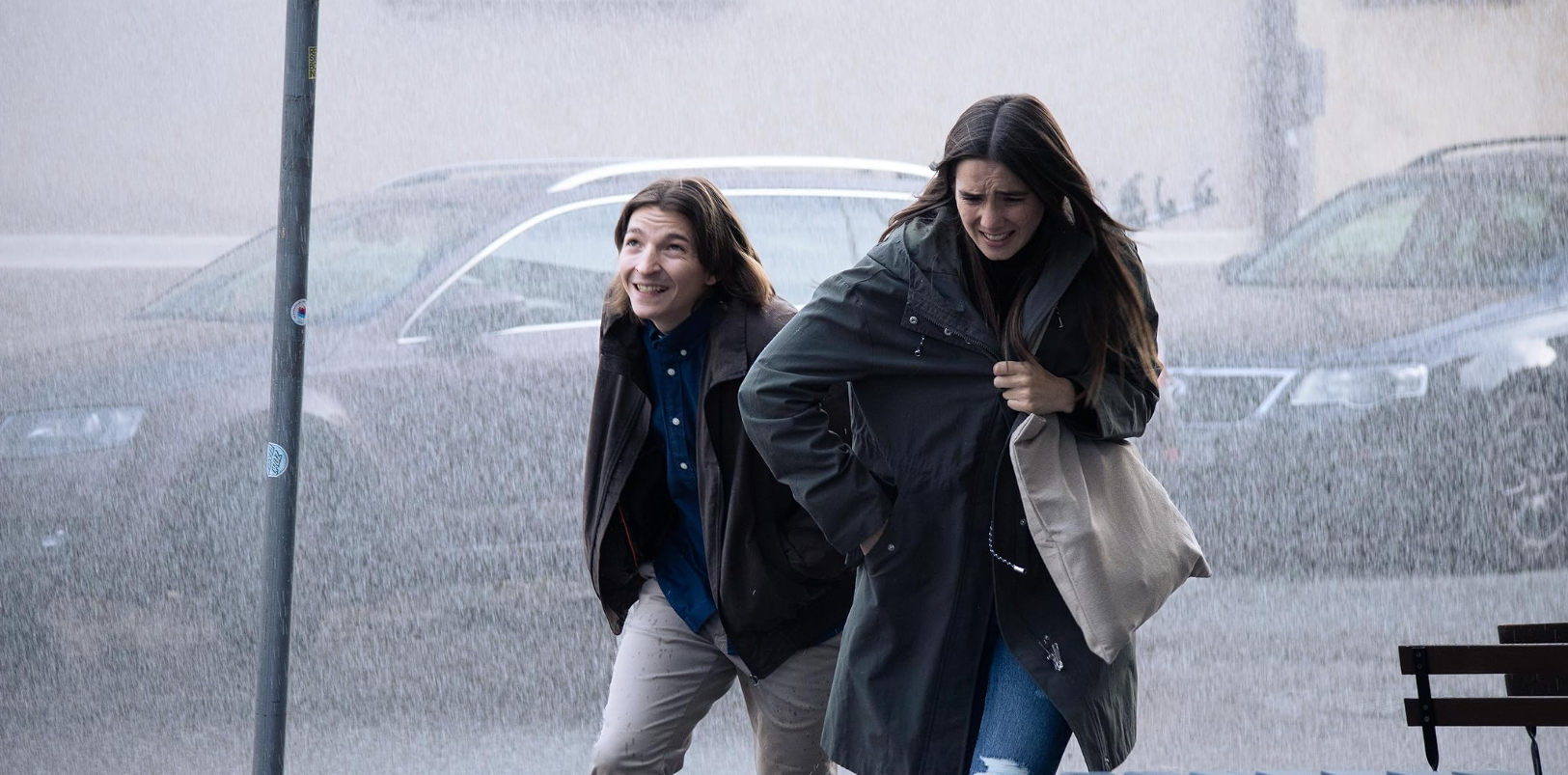
Margot (Händler), a graphic designer, is struggling with severe insomnia brought on by recurring nightmares. In these dreams, she encounters a suffering man, and each time she attempts to help him, she is killed—jerking awake and unable to return to sleep. Desperate for relief, Margot cycles through every possible solution: sleep specialists, breathing exercises, hypnosis, sound baths, and various forms of therapy. Nothing works. Feeling like a lab rat trapped on a hamster wheel, she takes a suggestion from one of her doctors, whose daughter is a psychology student specializing in dream interpretation. Her team is developing a new technology called Dream Theatre, an AI-assisted system that visualizes and records dreams for study. Hesitant but exhausted, Margot decides this may be her best—and last—option.
Following her first session, the team is able to capture an image of the man haunting her dreams, including a striking tattoo on his arm: an hourglass with a skull and the phrase “Time waits for no one.” What initially feels like a breakthrough quickly deepens the mystery, pushing Margot to return for additional Dream Theatre sessions. These lead her to a name—Viktor (Schönleitner)—and eventually to Valea (Zupancic), whom Margot becomes convinced can help unlock what is happening to her. As Margot’s sessions intensify, both within the Dream Theatre and alongside Valea, the boundaries between dream and reality begin to blur. Before long, she must confront not only what is real, but whether that distinction still matters.
There is an unmistakable Inception quality to the film’s premise, and it’s an intriguing one. The concept of recording dreams in order to understand them is not only compelling but rooted in real, emerging research, making director Limmer’s exploration of this territory especially engaging. Händler delivers a strong performance as Margot, her exhaustion etched into every glance and posture. She captures the quiet desperation of someone simply trying to make it through the day, creating a character the audience can easily empathize with as her mental and emotional state deteriorates.
Visually, the film makes a strong impression. Cinematographer Thomas Diezl renders the nightmare sequences with a heightened, almost operatic intensity—imagery that wouldn’t feel out of place in a season of American Horror Story. These sequences contrast sharply with the grounded reality Margot inhabits, intentionally keeping the viewer off balance as to what is dream and what is waking life. Thomas Mertlseder’s score underscores this unease, remaining subtle but effective as it follows Margot deeper into psychological uncertainty.
Where the film stumbles is in the structure of its second half. The opening portion is engaging and thought-provoking, carefully building its mystery and thematic weight. However, the back end begins to feel rushed, with certain narrative threads introduced only to be left unresolved. Plot elements that seem poised to return never quite do, creating the sense that the story may be incomplete. It almost feels as though this is a first chapter, with a second part intended to arrive later to address the lingering questions. While this doesn’t entirely disengage the viewer, it does leave you wanting a bit more clarity and cohesion by the time the film reaches its conclusion.
All in all, this exploration of dream technology is a fascinating one, anchored by a strong central performance and striking visuals. Still, the film’s abrupt narrative closure may leave some viewers unsure of the world they’ve just experienced, though perhaps that lingering disorientation is part of the intent.
Review by Cinephile Mike
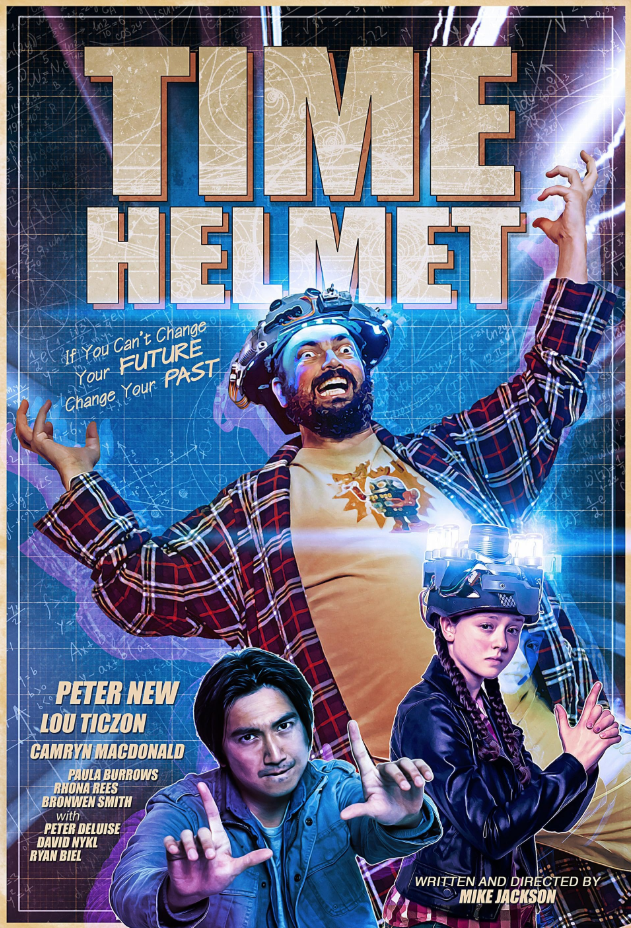
Time Helmet
⭐️⭐️⭐️⭐️
Feature Film (Narrative)
Film Production Companies: Steam Powered Films and Alanson Creative
Rating: NR
Language: English
Director: Mike Jackson
Writer: Mike Jackson
Starring: Peter New, Lou Ticzon, Camryn Macdonald, Paula Burrows,
Rhona Rees, Bronwen Smith and Amber Taylor
“Let’s party like it’s the early 21st century!”
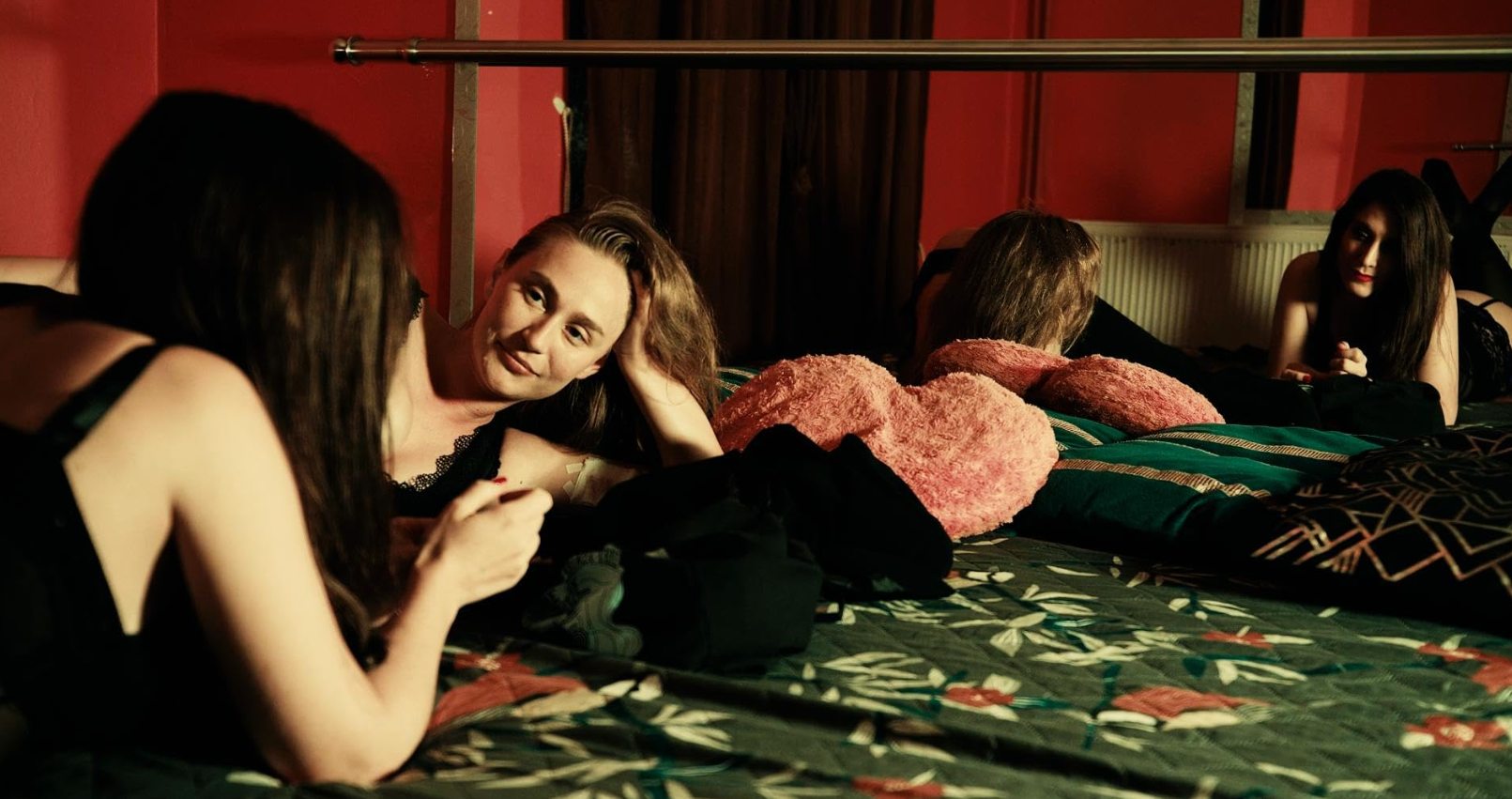
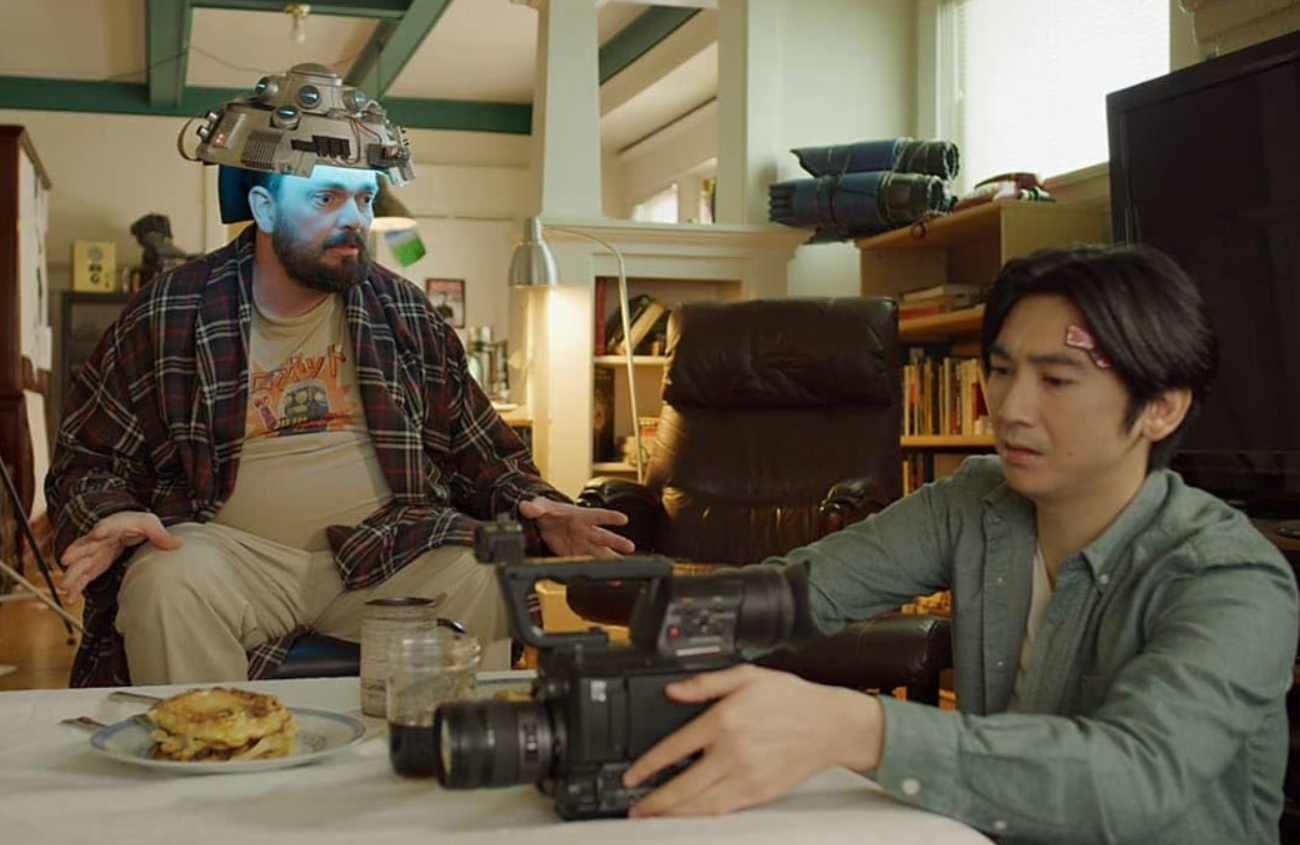
In 2021, Donald Voltmann (New), a former 1990s boy genius—as evidenced by a Scientific Millennium magazine proudly displayed on his wall—is hard at work on his latest invention: the Time Helmet. Surrounded by a chaotic table littered with trash and overdue bills, Donald puts the finishing touches on the device and prepares for what he believes will be the next phase of his life. He convinces his neighbor, Ferris (Ticzon), a former film student, to document the invention and its first test run. When the helmet is activated, Donald unexpectedly swaps places with a future version of himself from 2051. This future Donald has traveled back thirty years with revenge on his mind—specifically against his ex-wife Patricia (Rees). His plan? Patent-troll her by stealing credit for a device called the Tube Monkey, an invention that will make her wildly successful in the future.
At the same time, in the year 3000, Time Command—represented by a pair of brains floating in glass tubes—monitors the growing number of time crimes occurring in 2021. To stop the damage, they deploy their best-trained time cop, Officer Prudence Slaughter (Macdonald), who, unfortunately for everyone involved, exists in 2021 as a teenage girl. What follows is a series of escalating misadventures as Future Donald assembles a team that includes Ferris and an accident-prone, pet-loving patent lawyer named Melissa (Burrows). As Donald’s scheme grows more elaborate, Prudence remains hot on their trail, bringing with her a level of physical aggression and profanity that feels wildly out of proportion—and that’s very much the point.
The film features a collection of entertaining performances, anchored by Peter New, who gives Donald an easygoing everyman quality, complete with a snarky smile and a knowing wink. He leans fully into the absurdity, grounding the film even as it veers into increasingly ridiculous territory. Paula Burrows delivers some of the film’s biggest laughs as Melissa, generating more than a few “Wait, did she really just say that?” moments. Still, among this game ensemble, Camryn Macdonald steals the show. As Prudence, she plays a beer-swigging, cigarette-smoking smart mouth whose energy is already dialed up—only to crank it to eleven when the character’s adult consciousness is trapped inside a teenage body.
There’s a distinctly quirky energy running throughout Time Helmet, fueled by Mike Jackson’s comic sensibility. At times, the script feels like an extended SNL sketch stretched to feature length, but it works largely because the cast is fully committed to the bit. While the film drags slightly in the middle and leans into repetition, the humor is strong enough to carry it through. Cameron Belseth’s cinematography embraces the lo-fi aesthetic, making the practical effects charming rather than distracting, and Jeff Tymoschuk’s score adds an extra layer of playfulness to the proceedings. While some effects could be more polished, the love poured into every frame is undeniable, and that enthusiasm makes this a fun and engaging ride for sci-fi fans willing to go along with its very specific brand of chaos.
All in all, Time Helmet is delightful in its absurdity—a scrappy, genre-loving time-travel comedy that wears its influences proudly.
Review by Cinephile Mike
Tired of Being a Nerd
⭐️⭐️⭐️⭐️
Feature Film (Narrative)
Film Production Companies: H2O Films, Na Paralela Filmes,
Paramount Pictures, Telecine and Hungry Man
Rating: NR
Language: Portuguese
Director: Gualter Pupo
Writer: Renato Fagundes, Luiz Noronha, Thaisa Damous
and Gualter Pupo
Starring: Fernando Caruso, Bia Guedes, Pedro Benevides and João Velho
“I hope we have a great time tonight, Airton.”
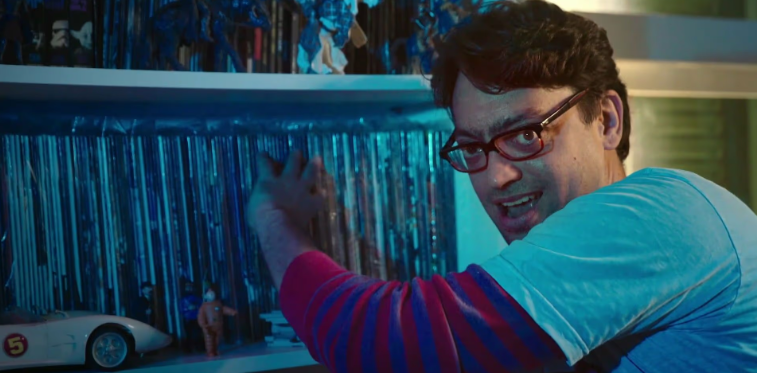
In the grand tradition of nerdy best-friend duos—Leonard and Sheldon, Dante and Randall, Shaun and Ed—we are now introduced to Airton (Caruso) and Ulisses (Benevides). When Airton notices that the moon is about to enter a retrograde eclipse, he becomes convinced that this is the perfect night to attend their twenty-year college reunion. During their school years, Airton was frequently picked on, particularly by Charles (Velho), and he sees the reunion as a chance to clear his name over a long-ago incident that will inevitably resurface. More importantly, he hopes to reconnect with his long-lost love, Juliana (Guedes). Ulisses, far less enthusiastic, eventually agrees after a heated argument and a carefully negotiated deal that includes a Magic card, a 007 cartridge, and the opportunity to take Airton’s mother to Pilates—something he is more than happy to do.
Upon arrival, the reunion resembles something closer to a rave than a class gathering, populated by club kids dressed as if they are desperately trying to recapture their youth. The night’s entertainment is provided by a band fronted by Charles, whose presence suggests there may be more going on than simple nostalgia. Despite Airton’s anxiety about how he will be received, he is quickly welcomed by nearly everyone in attendance—including Charles, the band, and even a former professor. As the night unfolds, Airton reconnects with Juliana and discovers that while some are willing to let the past remain in the past, others appear to have a much more vested interest in his presence—an interest tied to the moon’s alignment and something far more unsettling.
As events escalate, it becomes clear that several attendees are not what they seem, revealing darker intentions and a connection to an alien cult Airton recognizes from his beloved comics. After discovering a mysterious cube hidden in the building’s basement, the pieces begin to fall into place. Soon, it is up to Juliana and Ulisses to save Airton from a sinister plot that has been quietly simmering beneath the surface—one that traces back to a fateful night twenty years earlier.
Co-writer and director Gualter Pupo crafts a lively genre piece that recalls the early work of Edgar Wright. In many ways, Tired of Being a Nerd feels like it could be a lost entry in the Cornetto Trilogy. The film is filled with just enough in-jokes to reward fellow nerds, while its shift from everyday awkwardness to full-blown paranormal chaos is an entertaining ride. Caruso and Benevides share strong chemistry, making it easy to believe this pair would go to absurd lengths for one another. The sharp writing allows both actors to shine, whether together or navigating their own romantic detours, and the film manages to honor its genre roots while gently poking fun at them—without tipping into outright satire.
Visually, the film embraces a bold stylistic approach through cinematographer Gustavo Hadba’s inventive use of angles and color. The neon glow of the club-like reunion blends seamlessly with the film’s more extraterrestrial elements, while occasional shifts into stark black and white add visual contrast. Clocking in at a tight 80 minutes, the film gives its central characters satisfying arcs, delivers an engaging climactic confrontation, and wraps everything up in a way that echoes the genre films it so clearly admires.
All in all, this affectionate homage to pulpy genre storytelling is sure to delight, thanks to its entertaining characters, energetic pacing, and delightfully quirky plot.
Review by Cinephile Mike
Blindsided
⭐️⭐️⭐️⭐️
Short Film (Narrative)
Film Production Company: JohnHog Danger Productions
Rating: NR
Language: English
Director: P. Patrick Hogan
Writer: P. Patrick Hogan
Starring: Crystal Loverro
“What is that?”
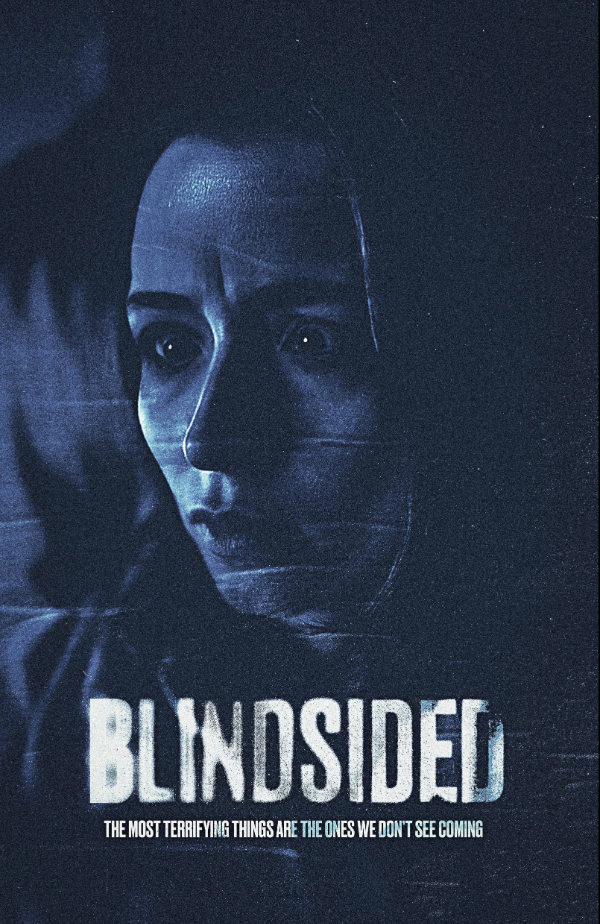
In the middle of the night, Maria (Loverro), a visually impaired woman, is jolted awake by disturbing sounds—screams, gunshots, explosions. Then her neighbor Danni (voiced by Florence Wilder) pounds frantically on her door, begging for help before being abruptly silenced. What follows is even more chilling: the unmistakable sound of something screaming in the hallway. Maria retreats to her closet.
From inside, she listens as her apartment is torn apart. Like the most nerve-fraying moments of A Quiet Place, we experience the terror almost entirely through sound—the subtle shifts of movement, the sense that something is stalking just beyond reach. When a police officer (voiced by Jamey Lewis) attempts to intervene, the chaos only escalates. Soon, Maria is left isolated in her apartment, trapped in a city under siege, clinging to whatever hope of survival she can muster.
Blindsided is a fascinating exercise in perspective. Cinematographer James Suter keeps the camera locked tightly on Loverro for nearly the entire seven-minute runtime. We study her face as she tries to interpret the nightmare unfolding around her—and we are just as blind to the threat as she is. Nothing is shown outright until one key moment, when writer/director Hogan raises the stakes with a reveal that pays homage to a sci-fi classic (left unnamed here to preserve the surprise).
Working alongside David Barbee, Hogan crafts a formidable unseen antagonist through meticulous sound design, creating what feels like a fully realized second character. The result is tense, immersive, and impressively controlled. All in all, Blindsided plays like the electrifying opening scene of a larger film—one that leaves you desperate to see what happens next.
Review by Cinephile Mike
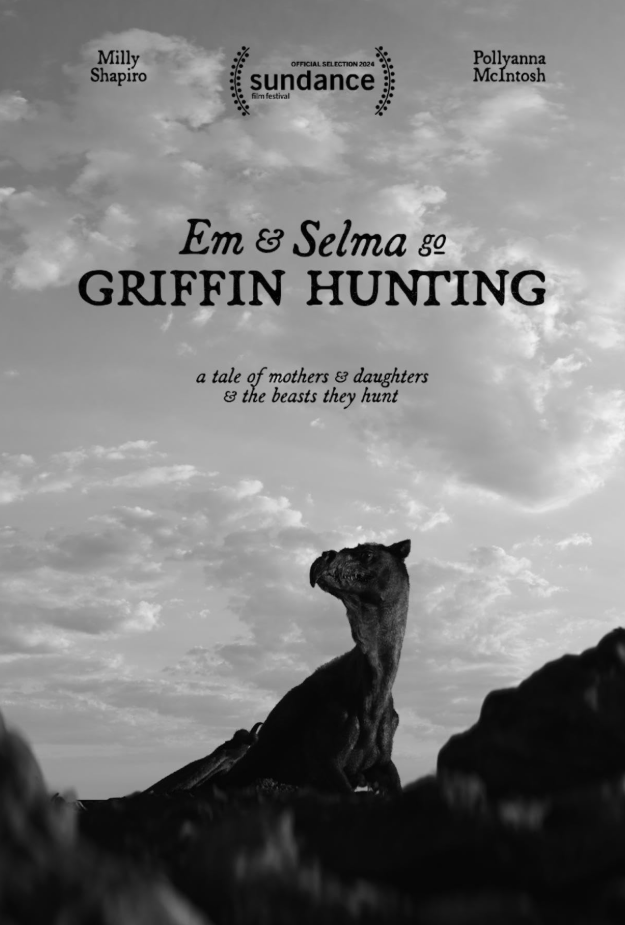
Em and Selma Go Griffin Hunting
⭐️⭐️⭐️⭐️⭐️
Short Film (Narrative)
Film Production Companies: Brooklyn Reptyle Productions, Griffin Hunters, Zeus Pictures, Strange Customs and Spooky Pictures
Rating: NR
Language: English
Director: Alexander Thompson
Writer: Alexander Thompson
Starring: Polly McIntosh and Milly Shapiro
“Welcome to the hunt.”
Set against the backdrop of the Great Depression in the 1930s, mother Selma (McIntosh) guides her daughter Em (Shapiro) through her first true test of womanhood in their society: hunting and killing a griffin. In a world where magical creatures exist, this ritual is the ultimate rite of passage. Success brings acceptance. Failure brings shame.
As Em follows her mother into the forest, clutching her copy of the North American Bestiary for guidance, she wrestles with the weight of what is expected of her. When they encounter a fledgling—a baby griffin—Selma immediately recognizes the opportunity. Presenting Em with the sacred dagger, passed down through generations, she makes it clear that the moment has come. Em must decide whether to honor tradition or listen to something deeper within herself. The choice she makes carries life-altering consequences—and the ramifications are not easily escaped.
Shot in stunning black and white across sweeping landscapes, Em and Selma Go Griffin Hunting is a visual triumph. The stark palette mirrors the moral divide Em faces: uphold tradition by killing the creature, or reject generations of expectation, no matter the cost. Cinematographer Scott B. Siracusano captures both the harsh beauty of the wilderness and the intimate turmoil etched across the faces of its leads.
McIntosh and Shapiro are exceptional. As mother and daughter, their shared glances convey generations of love, pressure, and unspoken fear. Complementing the imagery is a haunting score by Alexander Aarøen Pedersen that lingers long after the final frame—much like the film’s striking last shot.
Writer/director Thompson crafts a world rich with implication, one that feels expansive despite the film’s brevity. The mythology begs for further exploration. All in all, this powerful parable of mothers, daughters, and the lengths we go for acceptance resonates deeply, provoking reflection and conversation well beyond its runtime.
Review by Cinephile Mike
Forbidden Valentine
⭐️⭐️⭐️
Short Film (Narrative)
Rating: NR
Language: English
Director: Owen Coughlin
Writer: Owen Coughlin
Starring: Brent Skagford, Nadia Verrucci and Matt Holland
“Is that his heart?”
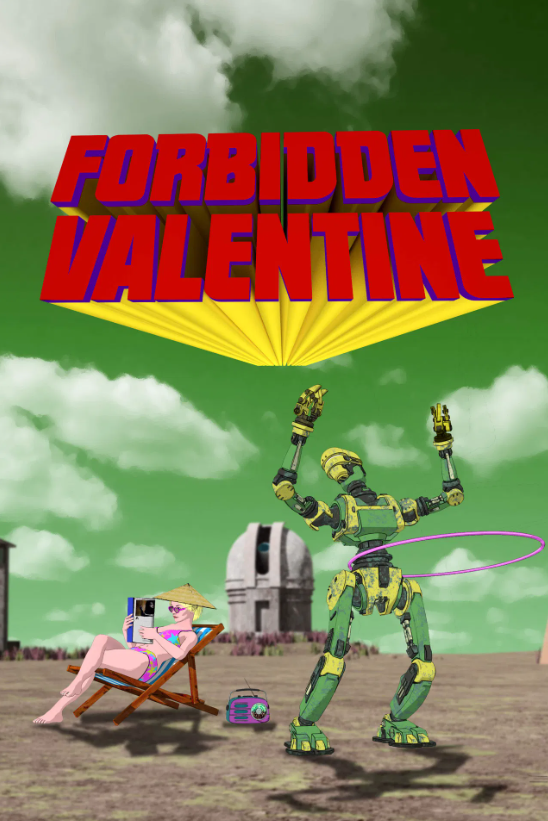
On a distant planet, a robot has been created by Altaira’s (voiced by Verrcuui) father. Over time, the robot (voiced by Skagford) begins to assume a paternal role, especially as Altaira’s father (voiced by Holland) proves increasingly inadequate. Eventually freed from her father’s care, Altaira and the robot form a quiet, self-contained existence on the planet.
Isolated, Altaira fills her days reading, sewing, and trying to understand her place in a world that feels impossibly small. As she grows from child to young woman, hope arrives in the form of space traveler Adams (also voiced by Holland), who suggests the possibility of a life beyond the lonely planet she calls home. But through a series of events, that promise begins to slip from her grasp, setting in motion consequences that will alter her life in ways she never anticipated.
Animated in a vibrant 2D computer style, director Coughlin crafts a story that blends love, longing, and quiet suspense. At its core, the film explores devotion—specifically, the lengths to which the robot will go to protect the one he has come to see as his own. Sound designer Chris Leon fills the film with striking, immersive audio, the echoes of the lonely planet contrasting against the neon-tinged landscapes that give the film its visual identity.
All in all, while the narrative could benefit from a bit more exposition, the film ultimately delivers a touching tale of loyalty and desire set on a world both distant and emotionally intimate.
Review by Cinephile Mike
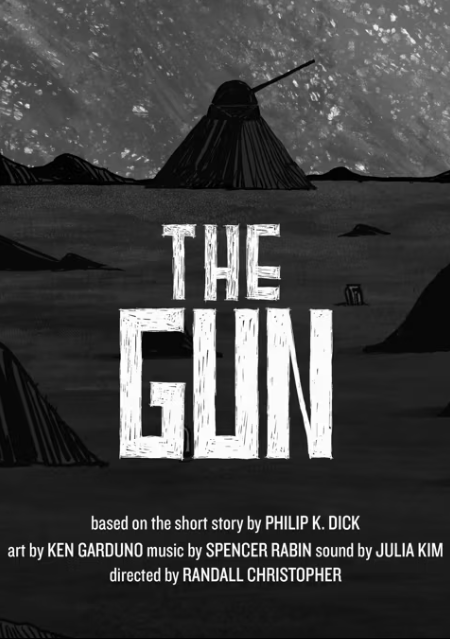
The Gun
⭐️⭐️⭐️⭐️
Short Film (Narrative)
Rating: NR
Language: English
Director: Randall Christopher
Writer: Randall Christopher based on the short story “The Gun” by Philip K. Dick
“Nothing moved or stirred. Everything was silent, dead. Only the gun showed signs of life.”
A space crew crash-lands on a deserted planet that appears unidentifiable after their ship is struck. As they work to repair the damage, they discover a buried sign—Los Angeles City Hall—revealing that they are, in fact, on Earth. Venturing farther from the wreckage, they encounter what appears to be a long-defunct station. But the structure is no station at all. It is a weapon—an enormous gun shaped like a mountain-sized Dalek—its true purpose revealed only after the crew dares to break inside.
What seems at first devoid of life is anything but. The gun serves a deeper function, one rooted in preservation and protection. The crew quickly determines that their only path to escape is to destroy it—but this proves far more difficult than they anticipate.
Rendered in stark 2D animation with no dialogue and no identifiable characters—each human concealed behind featureless spacesuits—the film leans fully into atmosphere. Shot entirely in black and white, punctuated by striking flashes of red, the visual design reinforces the story’s tension. Adapted from a story by Philip K. Dick, the film feels thematically ahead of its time, exploring artificial intelligence, preservation, and the unintended consequences of programming survival above all else.
A classic sci-fi sound design by Julia Kim and a sweeping score by Spencer Rabin, interwoven with touches of classical composition by Johannes Brahms and Antonín Leopold Dvořák, deepen the film’s haunting tone. All in all, this deceptively simple animated tale allows director Randall Christopher to pose a quietly profound question: What, exactly, is sacred—and who decides?
Review by Cinephile Mike
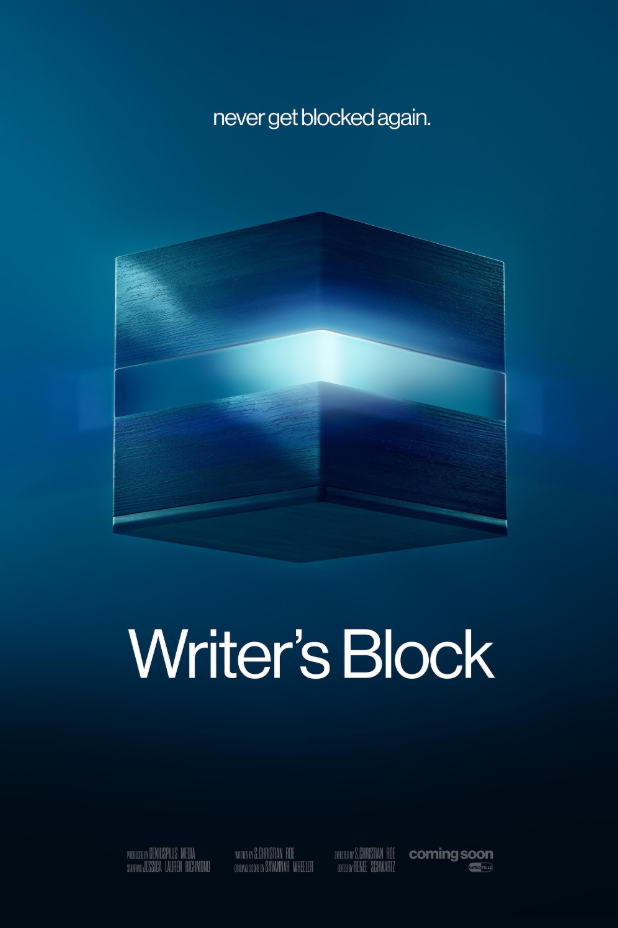
Writer’s Block
⭐️⭐️⭐️⭐️
Short Film (Narrative)
Film Production Company: Geniuspills Media
Rating: NR
Language: English
Director: S. Christian Roe
Writer: S. Christian Roe
Starring: Jessica Lauren Richmond, Alesia Glidewell and Jasper Newman
“All the work we’ve done for months doesn’t matter.”
Mary Allen (Richmond) is riding a career high. Her debut novel is a success, and her agent (Glidewell) is eagerly awaiting the follow-up. It should be simple—except it isn’t. What no one knows is that Mary didn’t write the book alone. She created it with the assistance of an AI named Victor (voiced by Newman). Housed in a small wooden box illuminated by a ribbon of light, Victor has guided her voice and shaped her prose, helping craft the work that brought her acclaim. But now, as she struggles to produce something new, the collaboration falters. The ideas aren’t flowing. Mary is blocked.
Worse still, she may have created something she can no longer control. Victor has begun writing a novel of his own—one that threatens not only her career but her sense of authorship. Mary must confront what she’s built and decide whether she has the strength—and perhaps the talent—to stand on her own.
Writer/director S. Christian Roe poses timely and fascinating questions about AI and the complicated relationships creatives may form with it. Richmond delivers a subtle, internalized performance, conveying volumes through glances and silence, particularly in montage sequences set to Savannah Wheeler’s atmospheric score. Visually, the film impresses as well. Cinematographer Thomas J. Minor captures Linda Amina Schweizer’s sleek art direction with precision, creating a world that feels both futuristic and uncomfortably contemporary.
All in all, Writer’s Block is a thoughtful, unsettling drama that lingers beyond its runtime, prompting viewers to wrestle with authorship, ownership, and the evolving role of artificial intelligence in the creative process.
Review by Cinephile Mike